
© Public Domain
Areas of Intervention
Updated at 26/05/2026
To achieve its goals, and always bearing in mind the public interest and the sustainable development of natural resources, the Foundation will mainly finance recurrent costs in the following activities:
- Conservation and sustainable management of natural resources and of aquatic and terrestrial biodiversity;
- Management and development of the Conservation Areas, with priority given to financing the recurrent running costs of the CAs;
- Supporting subsistence activities for communities resident in the CAs and buffer zones, when these activities are undertaken in harmony with the objectives of conservation and result in a reduction in actions that degrade the environment;
- Research about biodiversity and ecological monitoring;
- Training staff and agents of the national conservation system and of other relevant sectors;
- Promotion of tourism and other activities that benefit conservation, within the limits of the bearing capacity of the environment, to the benefit of the local economy;
- Strengthening the awareness and participation of the interested parties in the protection and conservation of the national CAs through education and awareness of conservation and the value of the CAs.
The Four Pillars of the BIOFUND Strategic Plan
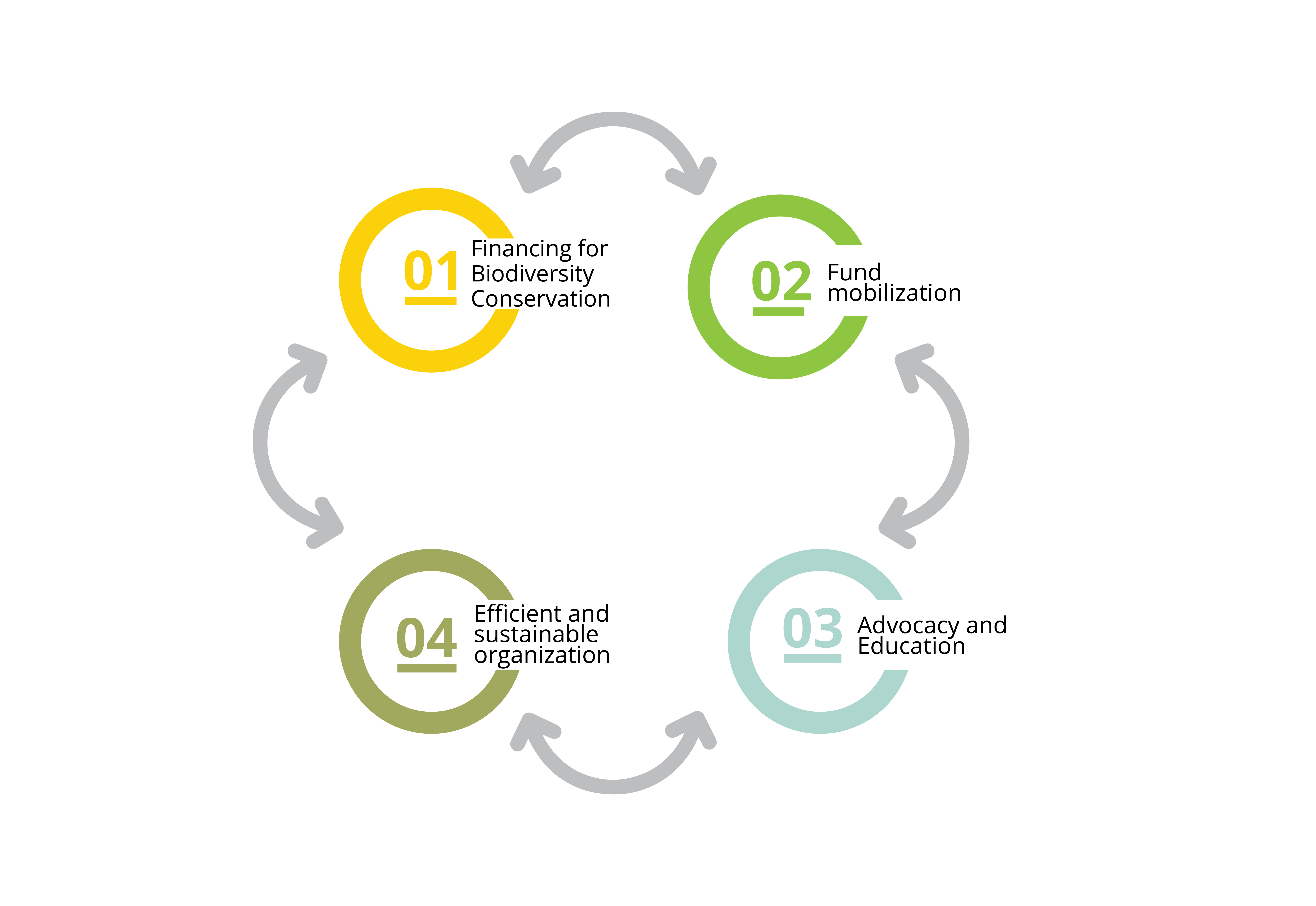
The Strategic Plan (SP) 2023–2027, developed through a broadly participatory process involving several ministries, the conservation community, and cooperation partners, clearly defines the main directions for action through four pillars that reflect the Foundation’s areas of focus and action, while contributing to the achievement of its mission. The first three pillars relate to BIOFUND’s strategic areas of intervention, while the fourth pillar refers to the Foundation’s institutional functioning.
In the previous Strategic Plan (2018–2022), the main focus was on institutional consolidation and the development of the technical capacity required to fulfil the functions of a Conservation Trust Fund (CTF). The current Plan sets out the full implementation of the Foundation’s core activities, including more systematic interventions on the status of biodiversity, expansion of the national network of Conservation Areas, advocacy, environmental education, and partnerships, as presented in the description of the pillars below.
The first pillar, Financing Biodiversity Conservation, represents the Foundation’s core mission and has been strengthened since the previous strategic plan. BIOFUND continues to fund the network of Conservation Areas and support initiatives that promote biodiversity conservation in Mozambique.
The second pillar, Resource Mobilization, focuses on mobilizing financial resources for the Endowment Fund and for project implementation. BIOFUND explores diverse funding sources, including traditional donors, multilateral funds, private investment, environmental compensation mechanisms, public debt conversion, and mechanisms linked to the green and blue economy.
The third pillar, Advocacy and Environmental Education, aims to promote policies that support biodiversity conservation and sustainability, while investing in environmental education at different levels of society. To strengthen its impact, BIOFUND intends to make communication more inclusive and implement an effective strategy with the involvement of multiple partners.
The fourth pillar, Efficient and Sustainable Organization, focuses on optimizing the institution’s organizational structure by promoting transparency, efficiency in fund management, and the retention of qualified talent. To achieve this, the Foundation strengthens its internal processes, risk management, Environmental and Social Safeguards, as well as the monitoring and evaluation of its initiatives, ensuring consistent and professional operations in partnership with stakeholders.