
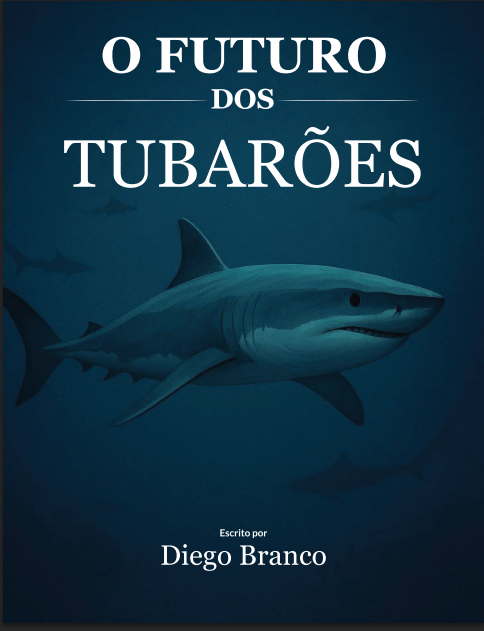
Written between the ages of 10 and 11 by Diego Branco, “O Futuro dos Tubarões / The Future of Sharks” explains the history, diversity and threats faced by these animals, which are essential for the health of the oceans.
Published at 19/12/2025
Young Mozambican author launches bilingual book on the future of sharks
Between the ages of 10 and 11, young Mozambican Diego Branco turned his curiosity about the sea into a true research project. The result is the bilingual book “O Futuro dos Tubarões / The Future of Sharks”, published by Ethale Publishing and sponsored by the association NATURA Moçambique, which is now available in digital format for schools, educators and the general public.
With a clear and visually very appealing approach, the book presents the world of sharks in an accessible way, from the prehistoric species that have swum in the oceans for hundreds of millions of years to the modern sharks that still inhabit the planet’s seas today. Readers will find explanations about the group’s taxonomy, anatomy, life cycle, the role of these animals as top predators and the main threats they face, such as overfishing and finning.
The book’s table of contents reveals the ambition and rigour of the work: in addition to the introduction and the summary, there are chapters dedicated to prehistoric sharks, various modern species (such as hammerhead shark, basking shark, tiger shark, great white shark, whale shark or lemon shark), as well as entire sections on the skeleton, skin, teeth, fins, sensory organs and life cycle of these animals. The book closes with a reflection on “The Future of Sharks”, curiosities (fun facts) and a bibliography that encourages readers to continue exploring the topic.
A scientific book born from a child’s curiosity
In the Author’s Note, illustrated with a photograph of Diego, the young author explains that the idea for the book was born from his interest in understanding which were the first sharks to populate the oceans and how they evolved into current species. This interest grew stronger during the isolation period caused by Covid-19, when he spent more than a year in Ponta do Ouro with his grandparents. It was in this context that he received encouragement to deepen his research, read books and online resources, and organise the knowledge in the form of a book.
Over many months, Diego read various scientific sources, consulted images, selected illustrations and structured the text with the support of his grandfather in guiding the research. Editorial coordination was led by Carlos Botomane, with text revision by António Branco and Augusto Nhampossa, and graphic design by Jonas Terceiro and the editor himself. The result is a work that combines scientific rigour, accessible language and attractive design, suitable for children, young people and families.
Sharks: far beyond the myths
Right in the introduction, Diego recalls that sharks have inhabited the oceans for more than 400 million years, long before the appearance of dinosaurs. Although they are sometimes seen as dangerous, the book stresses that attacks on people are rare and that the greatest threat does not come from sharks, but from human activities. Today, many species face the risk of extinction due to intensive commercial fishing, bycatch and the demand for fins.
In the scientific summary, the book shows how these animals help maintain the balance of marine ecosystems by controlling populations of other species and contributing to the health of coral reefs and seagrass meadows. The text also explains that there are around 500 known shark species, distributed across different orders and families, with very distinct shapes, sizes and ways of life – from giant filter-feeders, such as the whale shark, to small coastal predators.
A tool for environmental education in Mozambique
The final notes of the book indicate that the Portuguese and English versions will be distributed free of charge to schools and other institutions, and used in environmental education programmes developed by the association NATURA Moçambique. By making the content available in two languages, Diego and the project partners strengthen their ability to reach students, teachers and communities in different contexts, inside and outside Mozambique.
In a country with an extensive coastline and very rich marine ecosystems, the publication of a book of this kind by such a young author is an important contribution to forming new generations who are better informed and more committed to conservation. “O Futuro dos Tubarões” shows that a child’s curiosity, when supported by family, school and partner institutions, can become a powerful awareness-raising tool.
Access the full book in digital format: https://biofundorg.sharepoint.com/:b:/s/comunicacao/IQDTbqaWizTFTqSVwlFXZVafAXv-f-_9sPRVSg_zWx2Nf8w?e=pskiob
