
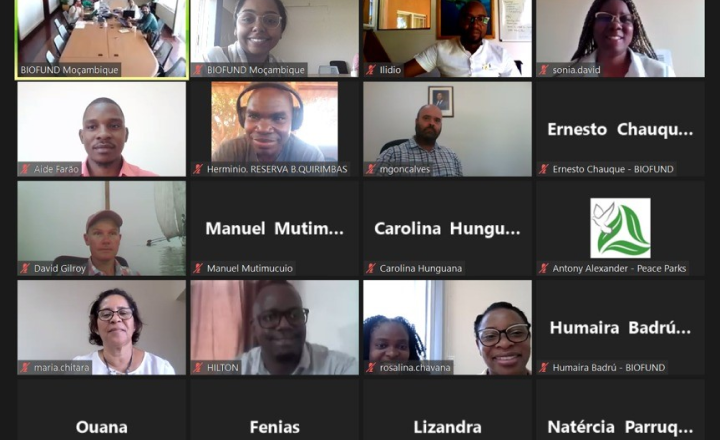
The Bee Project, part of the “Protected Areas and Elephant Conservation in Mozambique” (APEM) project, funded by the French Development Agency (AFD) and implemented by the Foundation for the Conservation of Biodiversity (BIOFUND) from 2016 to 2021, resulted in the protection of about 3 million hectares of biodiversity across 8 Conservation Areas. This information was shared during the virtual project review seminar held on 22 November 2022, which brought together the beneficiary Conservation Areas, donors, and partners.
Published at 25/11/2022
Bee Project Results in the Protection of 3 Million Hectares of Biodiversity
-
© PNZ
-
© BIOFUND
-
© David Gilroy
In this project, BIOFUND channelled over 2.4 million dollars to support 9% of the total operational costs in 8 marine and terrestrial Conservation Areas, namely: Limpopo National Park (PNL), Quirimbas National Park (PNQ), Gilé National Park (PNAG), Cabo de São Sebastião Total Protection Zone (Vilanculos Wildlife Sanctuary – SBV), Zinave National Park (PNZ), Bazaruto Archipelago National Park (PNAB), and Maputo National Park (PNAM), which encompasses the former Maputo Special Reserve (REM) and Ponta do Ouro Partial Marine Reserve (RMPPO).
The disbursed amount had a significant impact on the beneficiary Conservation Areas, especially in actions aimed at biodiversity protection and community development. It contributed to the increase in the number of patrols carried out, the promotion of income-generating activities for communities aligned with biodiversity conservation practices such as beekeeping, technical training, and environmental awareness for local communities. These Conservation Areas, both publicly and privately managed—some with co-management support—created opportunities for fruitful exchanges of experiences among themselves.
Through the Bee Project, it was possible to improve the living conditions of some families living around and within the Conservation Areas, through the hiring of community members for seasonal work such as road and infrastructure maintenance, ecological monitoring, among others. In the Vilanculos Wildlife Sanctuary, some seasonal workers later became permanent rangers of that Conservation Area. During the seminar, PNAB highlighted the operationalisation of patrol activities and environmental awareness through theatre as some of the main positive impacts of the project. These actions contributed to reducing poaching and improving the relationship between local communities and the Conservation Areas.
Regarding technical capacity building, the project ensured the annual delivery of training courses to managers of the beneficiary Conservation Areas in planning and financial management. This training added value to improving the administrative and financial capacity of the beneficiary areas, having increased by 35% since the beginning of the project (between 2016 and 2020).
During the project review seminar, beneficiaries highlighted the flexibility in accessing and applying project funds, which helped drive the activities carried out, especially in PNAM, where the administrator emphasized the complementarity between existing funding sources to achieve conservation programme goals in that Conservation Area. Also under this initiative, the beneficiary areas promoted synergies with the Leadership Program for the Conservation of Mozambique (PLCM), retaining some of the programme’s young interns.
The Bee Project was BIOFUND’s first major financing action for Conservation Areas, with the main objective of supporting non-salary recurrent costs. It was funded 80% by AFD and 20% by BIOFUND’s own resources. This project made it possible to test BIOFUND’s first procedures and monitoring and evaluation tools, as well as to train and build the capacity of beneficiaries, in synergy with other support such as the German Cooperation through KfW. It is important to note that this project marked the beginning of the Post-Bee Project, which ensures the long-term continuation of BIOFUND’s support to all 8 initial beneficiaries.
The strong performance of this project was vital in later leveraging additional support from other donors for the Conservation Areas through BIOFUND, such as the World Bank (MozBio project) and the European Union (PROMOVE Biodiversity project), demonstrating BIOFUND’s disbursement capacity. It was also one of the key factors in the growth of BIOFUND, which celebrates 10 years of existence.