
PROMOVE Biodiversidade, funded by the European Union, supports the process that led to the area’s recognition and stronger community organisation.
Published at 14/09/2026
Mount Mabu gains community conservation status to protect unique species and strengthen livelihoods
-
© BIOFUND / Rui Esmael
-
© BIOFUND / Rui Esmael
-
© BIOFUND / Rui Esmael
-
© BIOFUND / Rui Esmael
-
© BIOFUND / Rui Esmael
-
© BIOFUND / Rui Esmael
-
© BIOFUND / Rui Esmael
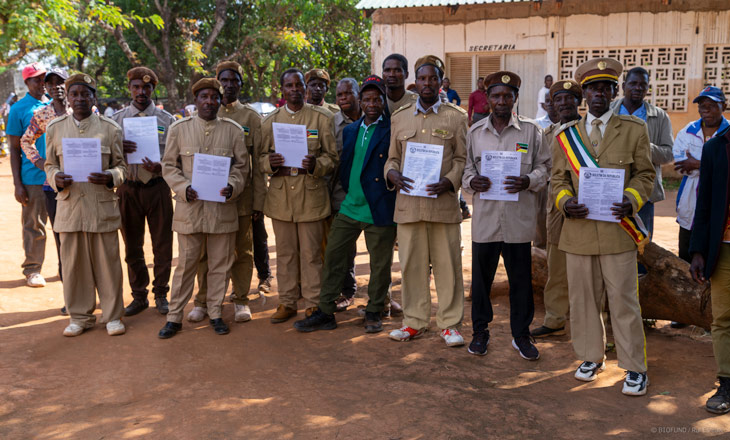
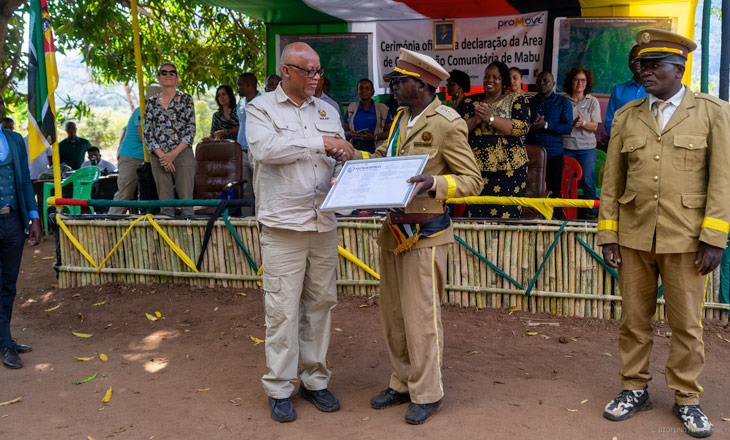
A forest that shelters unique species, feeds springs and sustains community life now has formal conservation status. The celebration of Mount Mabu’s designation as a Community Conservation Area brought together communities, the Government and partners around a shared responsibility: to protect this heritage and turn its natural value into opportunities for local development.
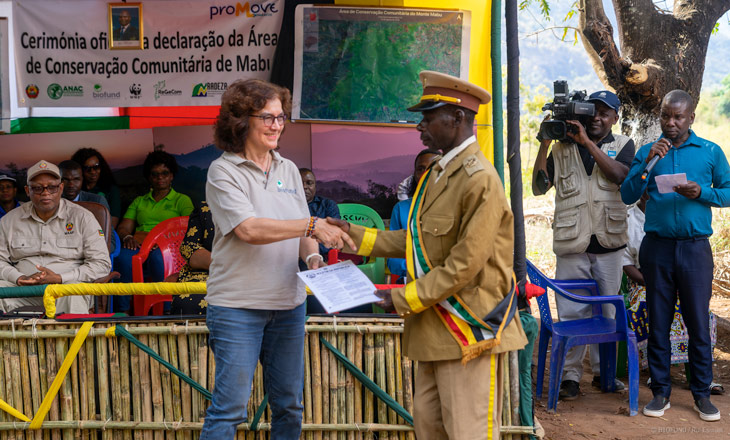
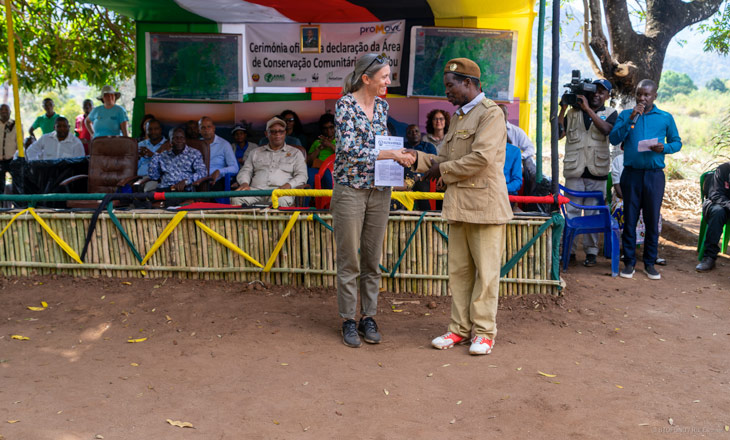
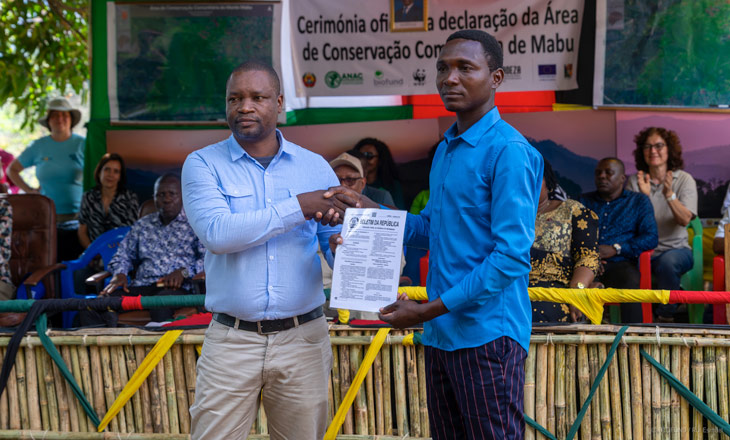
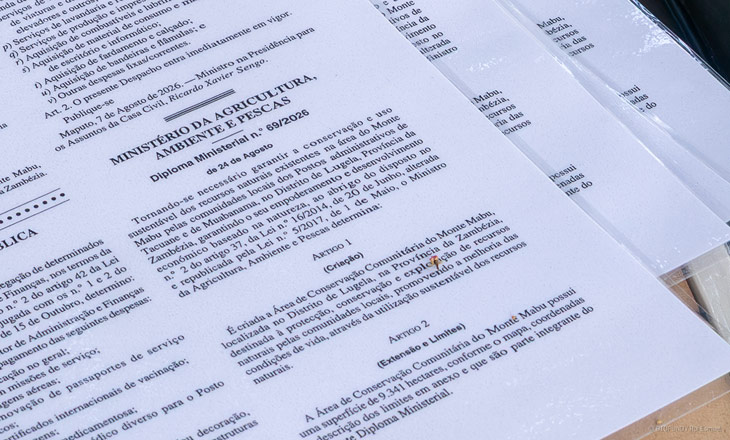
Established by Ministerial Diploma No. 69/2026, published on 24 August, the Mount Mabu Community Conservation Area covers 9,341 hectares. The ceremony that took place on the 11th of September 2026, in Lugela – Zambézia, marks the presentation to communities of a status already approved by the Government of Mozambique, recognising the importance of community participation in protecting and sustainably using natural resources.
In his remarks, the Secretary of State for Land and Environment at the Ministry of Agriculture, Environment and Fisheries highlighted the participatory management approach underpinning this conservation category: “Our State manages these conservation areas in a participatory manner, establishing appropriate mechanisms for the participation of public and community entities to ensure the preservation, conservation and restoration of landscapes.” He also stressed the importance of “conserving this very important landscape, where we also find a sacred forest and a place of great historical significance.”
A result of PROMOVE Biodiversidade
Formal recognition of the area is one of the main expected results of PROMOVE Biodiversidade’s work in Mabu. Funded by the European Union, the programme supported the work that connected scientific knowledge with community organisation and preparation of the legal recognition process. Studies, consultations, boundary demarcation and capacity development for local structures helped create the conditions for this achievement.
When work began in Mabu, the landscape did not yet have formal conservation-area status. Alexandra Jorge recalled this point to illustrate the scale of the journey and the need to proceed carefully: conservation and development opportunities should respond to community priorities rather than be imposed from outside.
BIOFUND manages the programme’s biodiversity conservation, community development and applied research components, working with the National Administration of Conservation Areas (ANAC), which is responsible for the institutional support component. On the ground, the consortium led by WWF, with ReGeCom and RADEZA, worked with communities and authorities at local, district, provincial and national levels.
Speaking on behalf of the WWF–RADEZA–ReGeCom consortium, its representative emphasised the decisive role of communities in conserving the landscape: “This achievement was not only the result of the efforts of those involved, but above all of the communities that have kept Mount Mabu as we find it today, ensuring through their local knowledge, traditions and way of managing the area that it has been maintained.”
Community organisation is central to this process. The creation of 11 community committees contributed to the establishment of the Community Association for the Conservation of Mount Mabu, CONSERVAMABU. The association gives communities their own structure through which to represent their interests and participate in managing the landscape.
European Union representative Anne-Aël Pohu, Team Leader for Resilience and Climate Change, addressed the communities with a message of recognition: “Because this achievement is yours.” In her remarks, she added: “The European Union feels deeply honoured to have been able to accompany and support this process.”
A forest of global importance
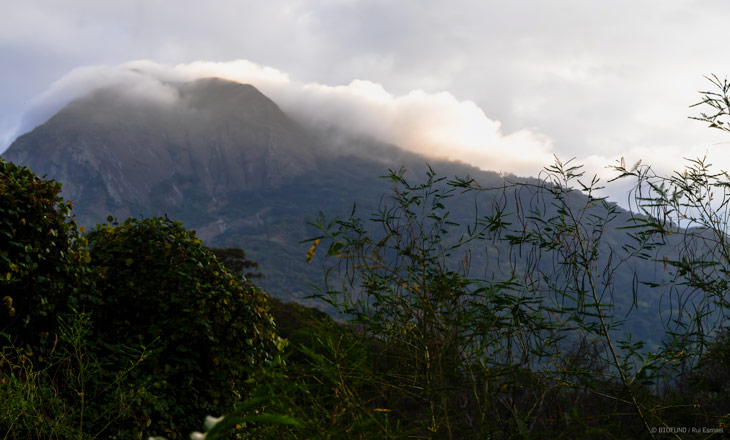
The Secretary of State also drew attention to the landscape’s ecological value: “This mountain, known as the Sky Island, has very important ecological indicators.”
Rising to around 1,700 metres, Mount Mabu shelters one of southern Africa’s most important medium-altitude moist forests and is recognised as a Key Biodiversity Area. Its species include the Mount Mabu pygmy chameleon, Rhampholeon maspictus, whose known distribution is restricted to this mountain. The Mount Mabu bush viper, Atheris mabuensis, and the small gecko Lygodactylus mabu are further examples of the biodiversity that makes this landscape so distinctive.
Protecting this forest also matters in everyday life. The springs and watercourses that depend on it support households and agriculture. Keeping the forest intact helps protect soils and the water resources that sustain economic activities within and beyond the area.
From conservation to income opportunities
PROMOVE Biodiversidade’s support for livelihoods includes sustainable agriculture and beekeeping. BIOFUND has also documented the development of bean and coffee value chains in partnership with the private sector. These activities can connect conservation with families’ needs, from food production to income earned through sales. Alexandra Jorge pointed to progress in the honey value chain as an encouraging sign that some of the solutions initially discussed with communities can work.
BIOFUND’s programme director, Alexandra Jorge, highlighted the need to expand the benefits: “We need to scale up beekeeping and sustainable conservation agriculture activities to generate tangible benefits for women, men and different generations.”
Nature tourism offers another opportunity. The forest, mountain landscapes and bird diversity provide potential for hiking, wildlife observation and visits accompanied by local guides. Developing this offer could create demand for accommodation, food and community products. Realising that potential requires training, access conditions and management that respects the forest and sites of cultural importance.
Alexandra Jorge also highlighted the importance of building CONSERVAMABU’s capacity to enter into agreements, manage resources and strengthen its autonomy with technical support. She linked that future to learning opportunities: “Education is also crucial; we support two schools and hope that other initiatives will extend that support.”
The next challenge is to consolidate the gains
Anne-Aël Pohu described Mabu as perhaps the most challenging of PROMOVE Biodiversidade’s three target areas, particularly in terms of access and logistics, while stressing the landscape’s potential for conservation, natural resources, biodiversity and community engagement. She also emphasised that sustainability requires a horizon beyond a single project cycle: “A five-year programme cannot by itself achieve significant change. This will take more time and will require more investment and more engagement in the future.”
Alexandra Jorge made the same point about continuity: “These actions need much more time than the normal duration of a project — three, four, five or six years.” She explained that BIOFUND’s ability to connect different sources of financing over time can help preserve what has already been built, reduce duplication and improve efficiency between projects. She summarised the logic simply: “The sum of one plus one is more than two.”
Anne-Aël Pohu and Alexandra Jorge also highlighted the complementarity of partners. Anne-Aël Pohu referred to private-sector engagement as part of a broader network and said: “Each actor has a role to play and we cannot work in isolation.” Alexandra Jorge highlighted, among other contributions, ReGeCom’s community mobilisation, Government support and the complementary expertise of WWF and RADEZA.
Legal recognition therefore opens a new phase for Mabu rather than marking an endpoint. Consolidating the work supported by PROMOVE Biodiversidade requires continued financing, local management capacity, coordination among partners and viable economic activities. The challenge is to turn the new status and the investments already made into a durable foundation for conserving the forest and gradually extending benefits to the communities that have protected it.