
Conserving the Monte Mabu forest not only protects one of Mozambique’s most important areas of biodiversity: it also helps regulate water, protect soils, reduce erosion and avoid economic costs associated with sediment transport resulting from the loss of forest cover which, under the scenarios analysed, can reach tens of millions of dollars.
Published at 02/10/2026
Monte Mabu: studies reveal the economic value of the forest and pave the way for debate on payments for ecosystem services
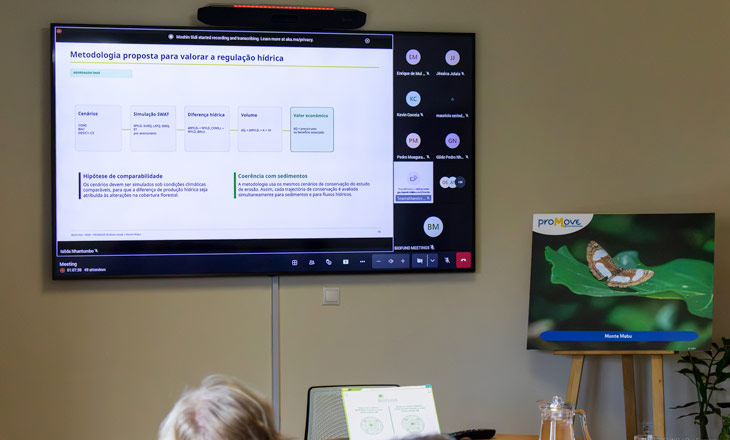
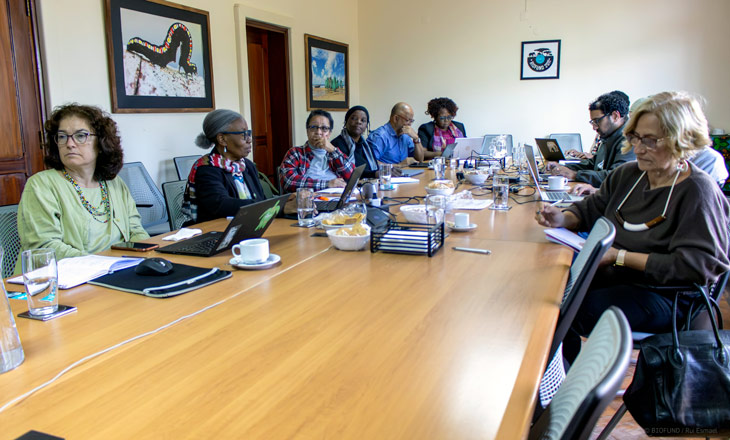
This was one of the main messages of the Seminar on the Economic Valuation of Mabu Hydrology and Payment for Ecosystem Services, held on 1 October 2026 under PROMOVE Biodiversity, a programme funded by the European Union. The meeting brought together representatives of public institutions, the private sector, academia, conservation organisations and development partners to analyse preliminary findings from studies on the economic value of the hydrological services provided by the Monte Mabu forest.
The forest as natural infrastructure
The studies presented examine a dimension of Monte Mabu that is not always immediately visible: the role of its forest cover in regulating water flows, retaining sediment and protecting downstream water systems.
“Monte Mabu’s forest cover is treated as natural infrastructure because it protects the soil, regulates water flows and avoids downstream economic costs.” – Osvaldo Samo
The study therefore reinforces the need to look at Mabu beyond biodiversity. As Osvaldo Samo emphasised, “we cannot look at Monte Mabu only in terms of biodiversity. We also have to look at Monte Mabu as water, as soil protection, as natural capital” when making conservation decisions.
The micro-catchments on Monte Mabu help feed the Lugela River and, subsequently, the Licungo River, on which communities, agriculture, economic activities and downstream water-supply systems depend. The hydrological assessment presented at the meeting also identified potential for irrigated agriculture, aquaculture, tourism, hydropower generation and other sustainable uses of water.
Losing forest also has an economic cost
One of the approaches presented sought to estimate the economic benefit of conservation through the sedimentation and dredging costs that can be avoided when tree cover is maintained.
The model found that, under higher-runoff conditions, the loss of one hectare of tree cover may be associated with the export of around 17 additional tonnes of sediment per year to downstream areas. The effect becomes particularly significant during wet periods and in sub-catchments with higher flows.
Eight (8) of the 15 sub-catchments analysed were therefore identified as priorities for this specific dimension of conservation because they present a greater risk of sediment transport under high-runoff conditions.
When the researchers translated these effects into potentially avoided dredging costs, the results made the economic dimension of conservation even clearer.
Considering a ten-year horizon, a 6% discount rate and a central dredging cost of USD 5.5 per tonne, the different conservation scenarios produced estimated benefits ranging from approximately USD 23 million to USD 91 million, while the progressive (more realistic) scenario produced a value close to USD 50 million.
These figures do not represent a total economic valuation of Monte Mabu. They relate specifically to the modelled benefits associated with potentially avoided sedimentation and dredging costs, under the assumptions used in the study.
Would those who benefit from the water be willing to contribute to maintaining the forest and, consequently, water availability and quality?
A second approach, presented by Gildo Nhanombe, examined the issue from the demand side: how much would users be willing to pay to maintain or improve the water-provision service?
The research analysed beneficiaries upstream and downstream of Monte Mabu and found a high stated willingness to contribute. During the discussion, the researcher clarified that around 97% of downstream respondents said they were willing to pay, while the comparative upstream analysis indicated a figure of approximately 96%. This finding shows that the population of Mabu places significant value on the forest and the hydrological service it provides.
The results also showed that economic capacity, age, gender, education, perceptions of water quality, environmental knowledge and type of user can influence willingness to pay. The study therefore recommends that any future mechanisms differentiate, for example, household consumers by social group (middle-income and those near the poverty line), companies and other economic users.
Those who benefit also need to understand where the service comes from
The study also identified an important difference between upstream and downstream areas: communities close to the conservation area have had greater exposure to conservation awareness activities, while many downstream beneficiaries know little about the link between the Monte Mabu forest and the water they use.
“Environmental education could not remain focused only on conservation areas or upstream; it needs to be expanded.” – Gildo Nhanombe
The researcher advocated expanding awareness-raising activities to areas that benefit from ecosystem services, as well as involving young people, women and other stakeholders in downstream areas, strengthening understanding of the relationship between conservation, water availability and the quality of ecosystem services.
From scientific evidence to a financing mechanism
The seminar was not limited to the question, “how much is water worth?”. An important part of the discussion focused on how to turn this value into a mechanism that effectively contributes to financing conservation.
Participants discussed questions such as who should pay, who should receive, how users should be differentiated, which institution could manage the resources, and how to ensure that payments correspond to verifiable conservation results.
The Costa Rican example was presented by Isilda Nhantumbo as a reference for the discussion. In that model, there is a legal framework, a defined source of financing, an intermediary institution that manages the resources, contracts with environmental-service providers, and a monitoring system that makes payments conditional on compliance with conservation obligations.
For Mozambique, the discussion pointed to the need to analyse the current legal framework, existing fees and the possibility of channelling part of the revenues associated with the use of water resources towards conservation.
It was also proposed that a meeting be held specifically on the legal and institutional framework, involving the National Directorate for Water Resources Management and other relevant stakeholders to further examine the possibility of introducing financing mechanisms linked to the conservation of water resources.
A new chapter for Monte Mabu
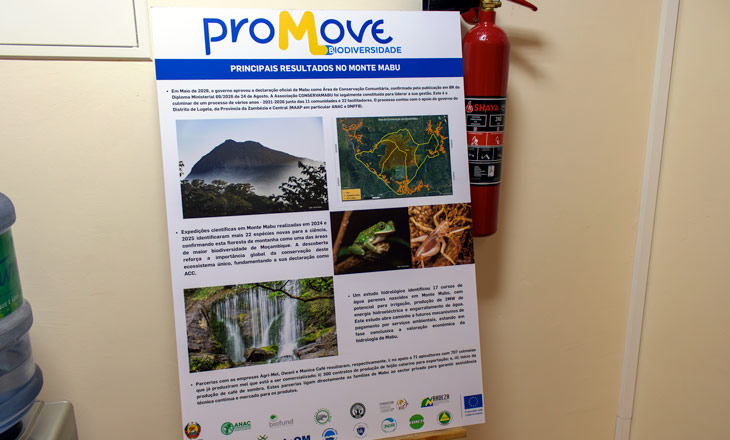
The discussion comes at a particularly important moment for Mabu. The forest, covering around 9,300 hectares, is associated with 11 communities and an estimated population of approximately 13,000 people. The process supported by PROMOVE Biodiversity contributed to the establishment of community committees and CONSERVAMABU, a structure linked to community management of the area.
Following recent progress in the formal recognition of the community conservation area, the studies presented add a new dimension to the discussion: conserving Mabu also means conserving water, reducing risks and protecting economic benefits that extend far beyond the boundaries of the forest.
The next challenge will be to transform this scientific and economic evidence into instruments that ensure that those who benefit from the services provided by ecosystems can also contribute to their maintenance.