
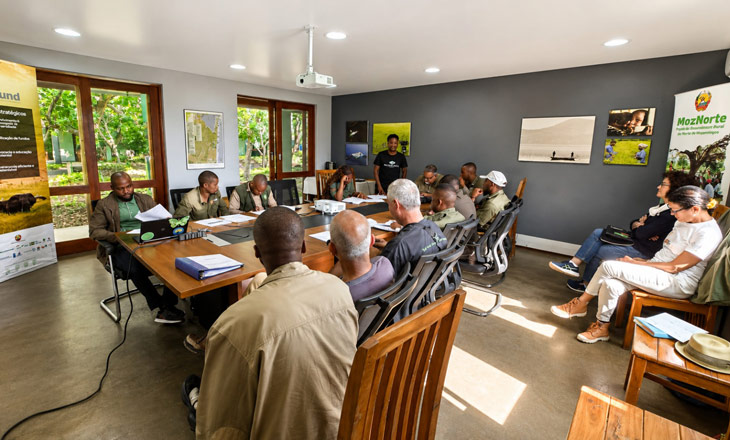
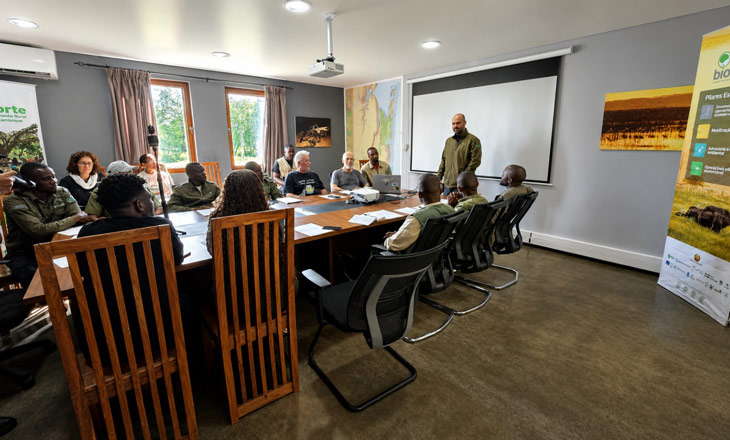
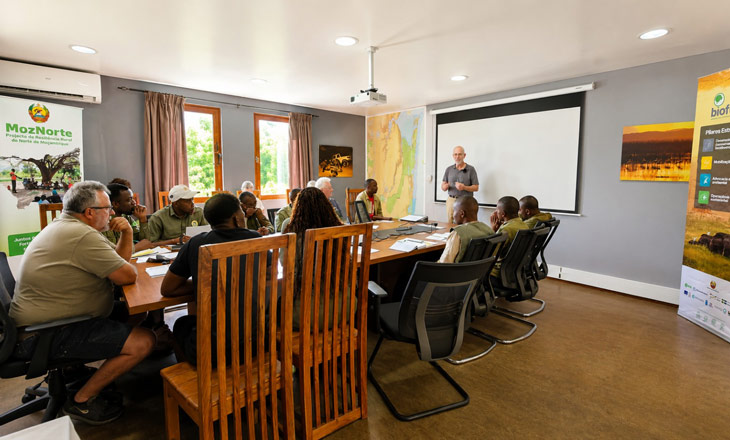
Technicians, rangers and communication officers from several Conservation Areas are taking part in a practical audiovisual production training, promoted under the partnership between ANAC and BIOFUND, with support from the MozNorte Project.
Published at 02/06/2026
Filmmaking Training Strengthens Capacity to Tell Conservation Stories in Mozambique
Technicians, rangers and communication officers from several Conservation Areas across Mozambique have begun a filmmaking training programme focused on biodiversity conservation at Maputo National Park. The initiative is being implemented under the partnership between the National Administration for Conservation Areas (ANAC) and the Foundation for the Conservation of Biodiversity (BIOFUND), with support from the MozNorte Project, financed by the World Bank.
The training is conducted within the framework of the Mozambique Conservation Leadership Programme (PLCM) and aims to strengthen practical audiovisual production skills, from story planning, image and sound capture, to editing and developing short, clear and relevant narratives for different audiences.
Over the course of approximately three weeks, participants will have the opportunity to work on topics related to biodiversity, wildlife, law enforcement, tourism, local communities, environmental education, environmental citizenship and conservation challenges.
During the opening session, the host of Maputo National Park (PNAM), Miguel Gonçalves (Administrator of Maputo National Park), welcomed participants and highlighted the importance of making the most of this opportunity in a place of high ecological and symbolic value for the country.
“Make the most of this opportunity in the only natural World Heritage site in our country,” he stated.
For BIOFUND, this training responds to the need to strengthen skills within the national conservation system, enabling professionals working directly in the field to better document what they observe, experience and protect.
Alexandra Jorge, BIOFUND’s Programmes Director, explained that the initiative is aligned with the Foundation’s role in promoting knowledge, capacity building and collaboration among partners.
“You will learn mechanisms and tools that can help document and disseminate information about wildlife, communities and Conservation Area staff,” she stated.
The BIOFUND representative also highlighted that this is a pilot experience with strong potential to be replicated in other Conservation Areas if results prove positive.
“Our hope is that you will be able to share and teach what you learn here with colleagues from your Conservation Areas,” she added.
The training is facilitated by Dave McGowan, an American professional with extensive international experience in film production for public institutions, non-governmental organisations and conservation-related initiatives. During his intervention, the trainer emphasised that the main objective of the programme is not to turn participants into professional filmmakers, but rather to equip them to communicate essential conservation messages more effectively.
“I do not make films for entertainment; I make films to communicate important messages to their intended audiences,” said Dave McGowan.
The trainer also stressed the importance of producing content tailored to local audiences, including the use of local languages whenever videos are intended for communities.
“Producing videos in local languages and presenting them to communities is a sign of respect for the communities themselves,” he emphasised.
Among participants, expectations are high. Dário Agostinho (Zambeze Delta Safaris) highlighted the importance of capturing events that are often unique and cannot be repeated.
“Sometimes, when we are in the field, something remarkable happens, but we do not have a camera. This training will be very valuable for documenting events that may never happen again,” he stated.
Batista Biscuete, who works in communications at PNAM, also highlighted the challenge of producing complete content with limited teams.
“In conservation, I am the producer — I have to write, film, edit, evaluate and monitor social media,” he explained.
For Rosa Ferrão (Lipiliche Wilderness), the training represents an opportunity to give greater visibility to the role of communities, women and young people in conservation.
“I hope to gain the ability to tell the conservation story through rural women, young people, rangers and conservation guards,” she stated.
The initiative reinforces the joint commitment of ANAC, BIOFUND and the MozNorte Project to strengthen the capacities of Conservation Areas by promoting communication that is more accessible, closer to communities and better connected to on-the-ground realities.
By investing in storytelling capacity, the training contributes to increasing the visibility of the work carried out in Conservation Areas, strengthening connections among communities, institutions and the general public, while recognizing the role of those who work daily to protect Mozambique’s biodiversity.